The cost of “just keeping the ad machine running” isn’t your CPM, it’s the tool stack.
Most performance teams still juggle 3–5 separate apps: a competitor spy tool, a swipe file manager, an analytics dashboard, and an AI creative generator.
The result is usually $200–$500/month in subscriptions, plus the real tax: context switching, fragmented reporting, and slow creative iteration.
This Skaler AI review looks at whether Skaler AI actually delivers on its central promise: consolidating the spy → analyze → create workflow into one platform (without feeling like a “jack of all trades, master of none”).
We tested Skaler across three common scenarios—solo e-commerce operator, small creative team, and agency workflow—to see where it shines and where it still has hard limitations.
Two details reduce the risk of testing: a 7-day free trial with no credit card required, and a notably aggressive 30-day “Winning Ads” money-back guarantee.
With that safety net in mind, let’s define what Skaler is—and what it isn’t—before we get into features, pricing, and alternatives.
Skaler AI Review Summary

Skaler AI
Skaler AI is an all-in-one ad platform for performance marketers.
Spy on competitors, analyze creative performance, and generate on-brand image ads and UGC in minutes.
With a 6M+ ads library and Meta analytics built in, it replaces four tools at a fraction of the cost.
SKALER AI — QUICK VERDICT
| Best For | Performance marketers, creative strategists, e-commerce brands, and digital agencies running Meta ads |
| Pricing | $49/month (Solo) · $83/month (Team) · $333/month (Agency) |
| Free Trial | ✅ 7 Days — No Credit Card Required |
| Guarantee | ✅ 30-Day Winning Ads Money-Back Guarantee |
| ✅ PROS | ❌ CONS |
|---|---|
| All-in-one spy + analyze + create Meta workflow | Credit limits can restrict heavy users |
| Strong competitive intelligence tools | |
| 6M+ ads library with spend proxies | |
| Meaningful cost savings vs. stacking multiple tools | |
| 100+ language localization |
[Start Free 7-Day Trial →] [Compare Plans →]
Quick findings
- Skaler’s biggest differentiator is workflow consolidation—research, analytics, and creation live in one place.
- Creative Analytics is the standout for Meta advertisers, especially for creative grouping and early fatigue signals.
- Brand Spy + Ad Discovery provide legit competitive intel beyond the free Meta Ad Library (filters + best-first sorting).
- The credit system is fair, but heavy creators can hit limits quickly (image generation typically costs 2–5 credits).
- The Solo plan is missing two of the most valuable modules (Brand Spy + Creative Analytics), which matters a lot.
- Social proof is solid: 200M+ ad spend analyzed, 6M+ ads in the library, 23K+ ads created, and 9-figure brand adoption.
If you want to compare Skaler AI to adjacent tools before committing, you can jump to our competitive ad tool comparisons later in this post.
What Is Skaler AI?
Skaler AI is an all-in-one ad intelligence and ad creation platform built for performance marketers and creative teams—especially those running Facebook and Instagram ads.
The product is designed around three pillars:
- Spy: Discover what competitors are running and identify likely winners using an ad library enhanced with filters, longevity signals, and estimated spend proxies.
- Analyze: Connect your Meta ad account and let Skaler automatically group and tag creatives so you can see patterns (not just campaign-level noise).
- Create: Generate new ads (images, product shots, UGC-style images, and video scripts) based on what’s working—without starting from scratch.
What Skaler is not: it isn’t a media buying tool, it doesn’t schedule/publish campaigns, and it isn’t a full video production suite that generates polished videos from scratch.
Skaler leans heavily into creative strategy and iteration speed.
The scale claims—200M+ ad spend analyzed and 6M+ ads in the library—matter because they hint at why the search, filtering, and winner pattern workflows are useful rather than gimmicky.
It also helps that Skaler positions itself as enterprise-credible (9-figure brands reportedly use it), while still offering pricing that’s accessible to smaller teams.
Skaler AI Features — A Practical Deep Dive
1) Creative Analytics — from messy data to clear direction
Creative Analytics is the module that most directly impacts ROI—because it reduces time-to-insight.
You connect your Meta ad account via OAuth, and Skaler pulls your ad data into a dashboard that’s faster to interpret than Ads Manager for creative decisions.
The key difference is creative grouping and AI tagging. Instead of reading performance across scattered ad sets and campaigns, you get performance by creative concept, format, hook, and other attributes.
In practice, that means you can answer questions like:
“Do UGC-style images outperform polished product shots for this offer?”
or
“Which hook angle is driving our best CTR but worst conversion rate?” without exporting CSVs. For teams running five or more campaigns, this removes a weekly ritual of pivot tables and half-trustworthy calculations.
The most valuable capability is ad fatigue detection. Skaler can flag creatives that are starting to decline before performance fully collapses.
That matters because by the time your CPA spikes in Ads Manager, you’ve often already wasted spend.
Security-wise, Skaler states the connection is secure and data stays inside the platform. Still, in any tool trial, you should connect a non-critical account first if you’re cautious.
User tip: connect your Meta account on day one of the free trial. If Skaler clicks for you anywhere, it’ll click here.
2) Brand Spy — your competitors’ playbook, unlocked
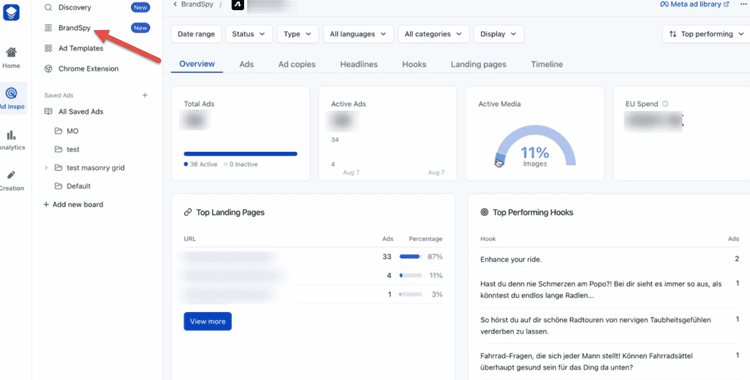
Brand Spy is Skaler’s “monitor competitors while you sleep” feature.
You add a brand or Facebook page to a watchlist, and Skaler tracks active ads over time—surfacing creatives ranked by longevity and estimated spend indicators.
This is more useful than manually browsing the Meta Ad Library because Skaler adds organization, persistence (saved ads don’t disappear with link expiry), and prioritization (best-first vs newest-first).
Where Brand Spy shines is in creative strategy mapping:
- What formats are they running (image vs video ratio)?
- What hooks do they repeat across ads?
- Which landing pages are they sending traffic to?
- How quickly do they rotate creatives (testing velocity)?
The spend data isn’t exact—it’s directional—but it’s still a practical proxy.
Ads that have been running for 30+ days are rarely “losers,” and that’s usually all you need for research shortlists.
Plan constraints matter:
- Solo Marketer: Brand Spy not included
- Creative Team: track 25 brands
- Agency Scale: track 150 brands
If competitive intel is your main reason for buying Skaler, you’re likely looking at Creative Team or above.
3) AI Ad Generator — from insight to launch-ready creative
Skaler’s AI Ad Generator turns a product URL or brief into multiple ad variations: on-brand image ads, product shots, and UGC-style images.
This isn’t “AI magic that replaces a creative team.”
The best way to think about it is as a creative multiplier: you bring strategy, offers, and constraints; Skaler outputs a batch of testable iterations fast.
Key creation modes include:
- Image variations to produce multiple layouts/headline/background combos from a reference.
- Product shot generator for studio-style visuals without a full shoot.
- UGC image generator to create authentic-looking images with people using the product (a strong DTC lever).
- Hook Studio for angle generation (problem/solution, curiosity, social proof, pattern-break).
- 100+ language translation with text reflow, which is more helpful than plain copy translation.
Important limitation: Skaler does not generate full videos from scratch. It can generate video scripts based on winning patterns, but you still need footage (or another tool) to produce the final video.
If video-from-scratch is your primary need, you’ll want to evaluate dedicated AI video generators too—see our review of Tagshop AI for a video-first alternative.
Credit usage is the practical constraint.
Images typically cost 2–5 credits each, so the Solo plan’s 200 credits translates to roughly 40–80 usable images/month depending on what you generate.
4) Ad Cloning — turn proven ads into on-brand winners
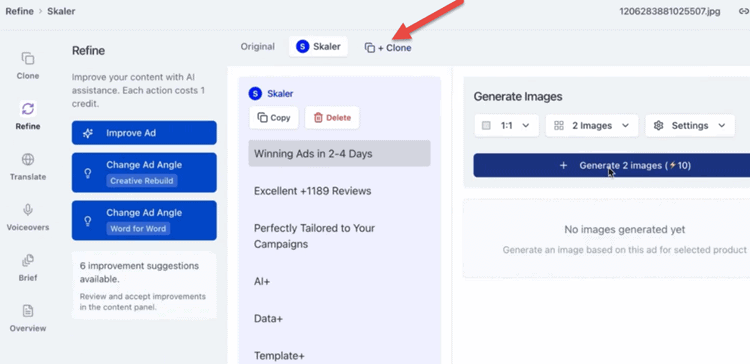
Ad Cloning is built for “start from a winner” workflows.
You import an ad (often from Meta Ad Library or Brand Spy), and Skaler reverse-engineers the structure—hook, layout, copy angle, CTA—then generates new, unique variations using your brand kit (colors, logo, tone, USPs).
This matters because it’s not about copying a competitor’s ad pixel-for-pixel.
It’s about borrowing structure and sequencing—the stuff that usually makes the ad work—then adapting it to your product and positioning.
Skaler also supports video script cloning: you paste a competitor video ad, and it outputs a structured script mapping hook → story arc → CTA.
Production is still on you, but the blank page problem disappears.
For a team under production pressure, this can easily save hours per sprint.
5) Ad Templates — 1,000+ proven formats ready to clone
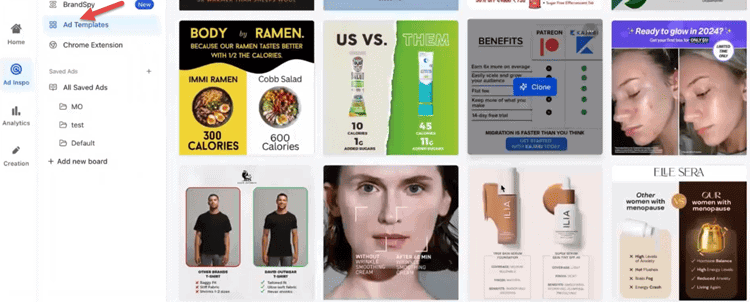
Skaler includes a library of 1,000+ curated image ad templates organized by performance-focused categories like testimonials, before/after, features-benefits, and sale/discount formats.
The best use is speed: pick a format that has historically worked, then clone into brand-ready variants in minutes.
Templates are primarily image-focused, not a full video template ecosystem.
If your workflow is 80% video, you’ll likely treat templates as supportive rather than central.
6) Ad Discovery — the Meta Ad Library, supercharged
Ad Discovery is essentially an enhanced Meta Ad Library experience.
The value isn’t “more ads.” It’s better discovery mechanics:
- Deep filters (keyword, brand, platform, country, language, media type, launch date, status)
- Best-first sorting by longevity or estimated spend proxies
- One-click save to boards or send to cloning
This is where Skaler becomes a research engine rather than a scrolling tool.
A practical workflow is to filter by country + keyword, then sort by longest-running to identify durable winners.
From there, save to your swipe file and build test batches.
7) Chrome Extension — multi-platform swipe file in one click
Skaler’s Chrome Extension is easy to overlook, but it’s legitimately useful.
It lets you save ads from multiple ad libraries (Meta, TikTok Creative Center, TikTok Ad Library, and LinkedIn Ad Library) into Skaler boards.
That’s valuable because inspiration doesn’t live on one channel anymore, and bookmarks/screenshots don’t scale.
Saved ads keep metadata (advertiser, platform, dates, status).
From there you can transcribe copy, translate it, and send it into the cloning workflow.
Collaboration is also better than random shared folders: teams can tag, comment, and keep boards organized by offer, funnel stage, or client.
Pricing and Plans — Is Skaler worth it?
Skaler offers three plans with annual discounts (“2 months free + all credits upfront” on annual billing), plus a 7-day free trial and a 30-day Winning Ads guarantee.
Pricing table
| Plan | Annual (per month) | Monthly | Best for | Credits / month |
|---|---|---|---|---|
| Solo Marketer | $49/mo | $59/mo | Solopreneurs who mainly want generation + saving | 200 |
| Creative Team | $83/mo | $99/mo | Small teams that need Brand Spy + Analytics | 500 |
| Agency Scale | $333/mo | $399/mo | Agencies with multiple accounts + higher output | 2500 |
What you’re really buying isn’t just credits—it’s the consolidation of tools.
If you currently pay for a spy tool + creative analytics + swipe file + AI generator, Skaler can be cheaper than stacking four subscriptions.
That said, the Solo plan is the tricky one: it’s affordable, but it omits Brand Spy and Creative Analytics—two of Skaler’s most defensible value drivers.
A simple rule:
- If your goal is “make more creatives faster,” Solo can work.
- If your goal is “outlearn competitors + measure what works,” Creative Team is usually the minimum viable plan.
If you’re comparing Skaler’s all-in-one approach to another platform that leans heavier into analytics limits and seats, cross-read our Atria AI review for an apples-to-oranges but useful benchmark.
Credit system (what most reviews don’t explain clearly)
Credits reset each billing cycle and are consumed by AI generation actions (images, product shots, UGC images, variations).
Copy generation and organizational features are typically free or low-cost.
A practical example:
- If a rendered image costs ~3 credits on average, then:
- 200 credits ≈ ~65 images/month
- 500 credits ≈ ~165 images/month
- 2500 credits ≈ ~830 images/month
If you run out of credits, you can’t perform credit-consuming generation until the next cycle (or you upgrade).
This is fair, but it means heavy creative testing teams should avoid underbuying.
It’s also why the annual billing “all credits upfront” can be attractive for sprint-based production.
Credits explain “how much you can produce.”
The next question most small brands ask is: how does that cost compare to paying a freelancer or a creative agency for iterations?
Is Skaler AI cheaper than hiring a freelancer or creative agency for ad iterations?
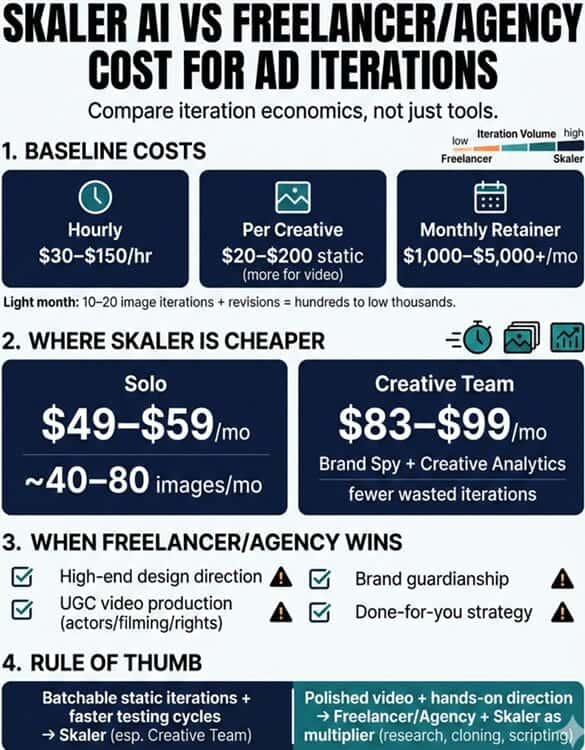
For small brands, the real comparison isn’t “Skaler AI vs a designer.” It’s Skaler AI vs the cost of iteration—because Meta performance usually improves when you can ship more tests per week and kill fatigued creatives faster.
The cost baseline (what you’re replacing)
Most freelance and agency models charge one of the following:
- Hourly (often $30–$150/hr depending on skill and market)
- Per creative (commonly $20–$200 per static, and significantly more for video)
- Monthly retainers (often $1,000–$5,000+/month for ongoing ad creative support)
For a small e-commerce brand that needs consistent testing, even a “light” month—say 10–20 new image iterations + a round of revisions—can easily land in the hundreds to low thousands.
Where Skaler can be meaningfully cheaper
Skaler becomes a cost-saver when your bottleneck is volume + speed, especially for static ads:
- Solo ($49–$59/mo): typically supports roughly 40–80 images/month (depending on credit cost per render). If you’re currently paying per-creative, that alone can undercut freelancer spend—with the big caveat that you still need someone to pick winners, write good briefs, and QA outputs.
- Creative Team ($83–$99/mo): is often the better value for “iteration economics” because it adds Brand Spy + Creative Analytics, which reduces wasted iterations. You’re not just generating more—you’re generating closer to what’s already working.
When a freelancer/agency is still the better deal
Skaler is not automatically cheaper if you need:
- High-end design direction (custom illustration, advanced compositing, premium typography)
- UGC video production (real actors, filming, editing, usage rights)
- Brand guardianship (a senior creative lead who maintains consistency across channels)
- Done-for-you strategy (offer development, positioning, landing page messaging)
In those cases, Skaler works best as a multiplier for your creative partner—not a replacement.
Practical “small brand” rule of thumb
- If you mainly need batchable image iterations and faster testing cycles, Skaler (especially Creative Team) is usually cheaper than ongoing freelance production.
- If you need polished video ads and hands-on creative direction, keep the freelancer/agency—and consider Skaler for research + cloning + scripting to reduce briefing time.
Pros and Cons
Pros:
Skaler is strongest when you want one platform to handle the ad workflow end-to-end.
The spy-to-clone flow is fast, and the creative analytics grouping is legitimately useful for decision-making.
The multi-language localization is also practical for brands scaling into new geos without rebuilding creatives from scratch.
Skaler also “feels” built for performance teams rather than generalist content teams.
The UI decisions, reporting outputs, and templates are oriented toward shipping tests.
The 30-day guarantee is unusually generous for SaaS, and it reduces buyer anxiety if you’re unsure.
Cons:
Credits can restrict heavy users, especially on Solo.
For some buyers, the “cheap plan” becomes a false economy once you actually try to scale output.
Real-world use cases (who it’s for)
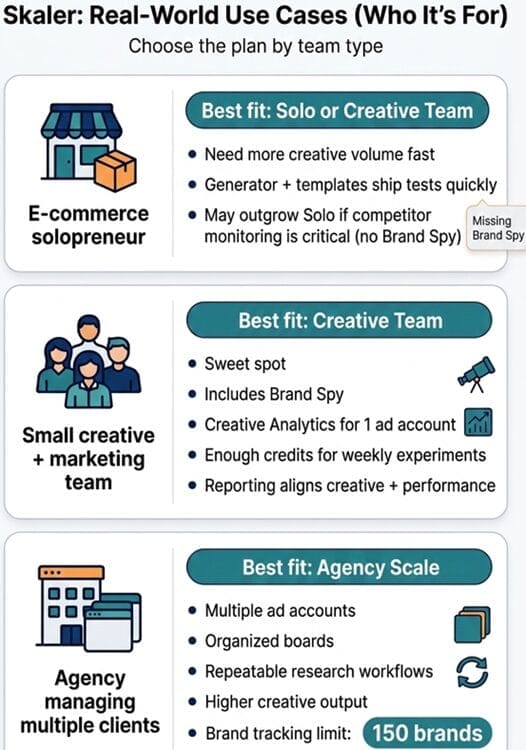
1) E-commerce solopreneur (best fit: Solo or Creative Team)
If you’re running a small store and need more creative volume without hiring designers immediately, Skaler’s generator + templates can ship tests quickly.
But if you rely on competitor monitoring to compete in a crowded niche, you’ll likely outgrow Solo fast due to the missing Brand Spy.
2) Small creative + marketing team (best fit: Creative Team)
This is the sweet spot.
You get Brand Spy, Creative Analytics for one ad account, and enough credits to run steady weekly experiments.
The reporting is also useful for aligning creative and performance stakeholders.
3) Agency managing multiple clients (best fit: Agency Scale)
Agency Scale makes sense if you manage multiple ad accounts and need organized boards, repeatable research workflows, and higher creative output.
Brand tracking limits (150 brands) also map better to agency life.
Skaler AI vs competitors (Atria AI, Tagshop AI, and “stacking tools”)
Skaler’s positioning is “one platform for spy + analyze + create,” heavily anchored in Meta.
Competitors tend to specialize:
- Atria AI leans more enterprise/team-workflow with higher starting price, more seats, and heavier analytics limits (ad spend analyzed per month). It’s often a fit when you need broader org features, asset storage, and multi-account infrastructure.
- Tagshop AI is video-first, leaning into AI avatars, URL-to-video, voice cloning, and rapid UGC video output. If your bottleneck is “we need 20 new video ads this week,” a video-native tool may outperform Skaler’s script-focused approach.
The alternative is building a stack: a spy tool + swipe file tool + analytics layer + creative generator.
That can be best-in-class, but it’s expensive and operationally messy.
Skaler wins when the value of consolidation (time saved + faster iteration) outweighs the benefits of specialized point solutions.
If you’re unsure which direction to take, start by mapping your constraint:
- Insight constraint → prioritize analytics
- Idea constraint → prioritize research/spy
- Output constraint → prioritize generation/video production
Expert opinion (our take after hands-on testing)

Skaler is worth the price if you value speed-to-learning and speed-to-iteration on Meta.
The platform’s best trait is that it makes the research → hypothesis → creative batch → measurement loop shorter.
That loop speed is often the difference between stable CPAs and creative fatigue death spirals.
Where Skaler is less compelling is when your business is video-first and you expect the tool to output finished videos end-to-end.
Skaler is a strategist’s generator, not a production studio.
The plan choice is the real decision lever.
Solo is priced attractively, but it’s missing Brand Spy and Creative Analytics—arguably the two most unique reasons to choose Skaler.
For most serious advertisers, Creative Team is where the product becomes “complete.”
If you’re on the fence, the free trial + 30-day guarantee makes this one of the safer tools to test.
Just go in with the right expectation: Skaler helps you learn and ship faster; it doesn’t replace your media buying judgement or your production pipeline.
Conclusion and verdict: Is Skaler AI worth it?
Skaler AI solves a real problem: the ad workflow is fragmented, and the teams that win are the ones who iterate faster with clearer creative direction.
Skaler’s Creative Analytics and competitive intelligence features meaningfully reduce guesswork, while the generator and cloning tools reduce blank canvas time.
It’s not perfect.
Credits force you to be intentional about output volume. But for Meta-heavy marketers and agencies who want an integrated spy + analyze + create loop, Skaler is one of the more practical all-in-one buys.
Recommendation:
- Choose Creative Team if you want the full value (Brand Spy + Analytics).
- Choose Solo only if your primary need is quick image generation + saving workflows.
- Choose Agency Scale if you manage multiple ad accounts and need volume + brand tracking.
Start your 7-day free trial and connect Meta on day one.
Compare plans and estimate your monthly credit needs before committing annually.